
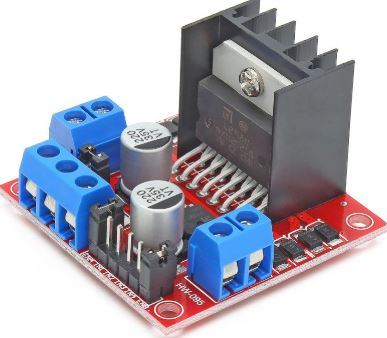
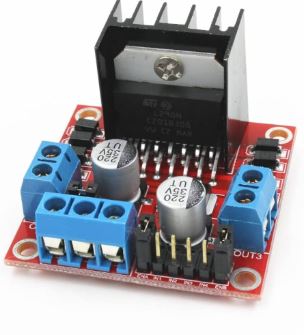
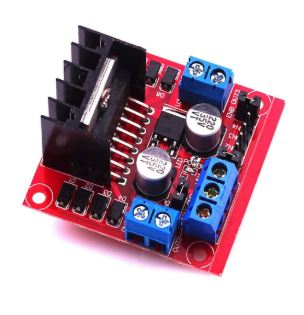
L298N Motor Driver Module
The L298N Motor Driver Module is a dual H-bridge motor controller capable of driving two DC motors or one stepper motor with direction and speed control, offering simple interfacing and reliable performance for robotics and basic automation projects, though with lower efficiency compared to modern drivers.
🔧 L298N Motor Driver Module
🧠 Main Controller
Driver IC: L298N dual H-bridge motor driver IC
Type: Dual H-Bridge motor driver
Function: Controls direction and speed of two DC motors or one stepper motor
⚡ Electrical Characteristics
Operating Voltage (Logic): 5V
Motor Supply Voltage (Vs): 5V to 35V
Max Output Current:
2A per channel (peak)
~1–1.5A continuous (with heatsink)
Total Power Dissipation: ~25W (with proper cooling)
🔌 Motor Control Capability
Motor Channels:
2 DC motors independently
OR 1 stepper motor
Control Type:
Bidirectional (forward / reverse)
Speed control via PWM
🔗 Input Control Pins
IN1, IN2: Control Motor A direction
IN3, IN4: Control Motor B direction
ENA: Enable pin for Motor A (PWM speed control)
ENB: Enable pin for Motor B (PWM speed control)
🔋 Output Pins
OUT1, OUT2: Motor A output
OUT3, OUT4: Motor B output
🔌 Power Pins
12V (VCC): Motor power supply input
5V: Logic power (input or output depending on jumper)
GND: Ground
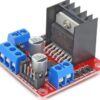
⚙️ Onboard Components
Voltage Regulator:
5V regulator (enabled via jumper)
Heatsink:
Aluminum heatsink for thermal dissipation
Flyback Diodes:
Protect against motor back EMF
Power LED Indicator
🔧 Jumper Settings
5V Enable Jumper:
ON → Uses onboard regulator (if motor supply ≤ 12V)
OFF → Requires external 5V supply
ENA / ENB Jumpers:
Installed → Motor always enabled
Removed → Use PWM for speed control
📊 Performance Characteristics
Control Logic: TTL compatible
Switching Type: Bipolar transistor-based H-bridge
Efficiency: Lower than modern MOSFET drivers (due to voltage drop ~2V)
Operating Temperature:
−25°C to +130°C (IC range)
📐 Physical Characteristics
Module Size: ~43 mm × 43 mm × 27 mm
Weight: ~25–30 g
Mounting: 4 screw holes
🔄 Working Principle
Uses H-bridge circuits to reverse motor polarity
Enables:
Forward rotation
Reverse rotation
Stop (brake or free run)
🧪 Typical Applications
Robotics (line follower, obstacle avoidance)
DIY RC cars
Conveyor systems
Stepper motor control
Automation projects
⚠️ Limitations
Voltage drop (~2V–4V) reduces motor efficiency
Generates heat under load
Not ideal for high-efficiency or battery-powered projects
Reviews
There are no reviews yet.